

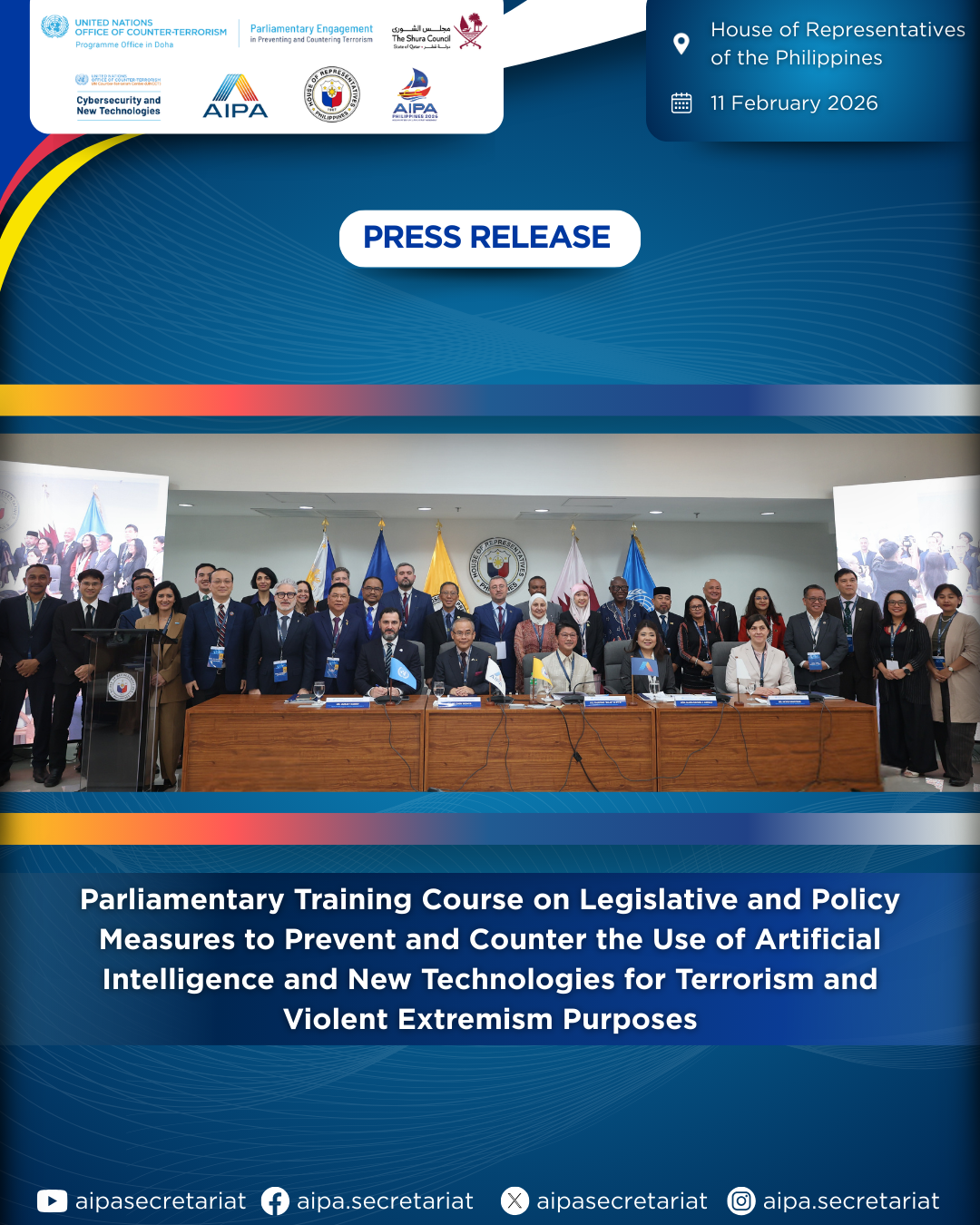
PRESS RELEASE Training to Strengthen Capacities of Parliamentarians to Address the use of Artificial Intelligence and New Technologies in Counter-Terrorism
Manila, Philippines, 11–13 February 2026 — A Parliamentary Training Course on “Legislative and Policy Measures to Prevent and Counter the Use of Artificial Intelligence and New Technologies for Terrorism and Violent Extremism Purposes,” took place from 11 to 13 February 2026, in Manila, Philippines. Hosted by the House of Representatives of the Philippines, the training was organized by the United Nations Office of Counter-Terrorism (UNOCT), through its Global Programme on Parliamentary Engagement in Preventing and Countering Terrorism and its Global Counter-Terrorism Programme on Cybersecurity and New Technologies, with the support of the Shura Council of the State of Qatar, and in partnership with the ASEAN Inter-Parliamentary Assembly (AIPA).The training brought together parliamentarians as well as representatives of parliamentary Assemblies from the ASEAN region and international parliamentary assemblies from Africa, Asia, Europe and the Middle East and North Africa. It aimed to strengthen their understanding of the opportunities and risks associated with artificial intelligence (AI) and new technologies in the context of preventing and countering terrorism and violent extremism conducive to terrorism (CT/PCVE). Participants examined the evolving misuse of these technologies by terrorist groups and discussed ways to strengthen legislative and oversight frameworks in line with international law, including international human rights law and international humanitarian law.
At the opening session, the Heads of UNOCT Global Programme on the Parliamentary Engagement in Preventing and Countering Terrorism and Global Counter-Terrorism Programme on Cybersecurity and New Technologies, Mr. Murad Tangiev and Ms. Akvile Giniotiene, highlighted that the training aimed to reinforce the critical role of parliaments in shaping legislative responses and exercising effective oversight to ensure that counter-terrorism measures remain effective, rights-based, and uphold international legal standards. They outlined the objectives of the training as supporting the development of national governance and regulatory approaches to the use of artificial intelligence in counter-terrorism efforts, while enhancing transparency and public trust in the of AI use in compliance with international law.
The AIPA Secretary-General, His Excellency Dr. Chem Widhya, stressed that “Rapid technological advances, including artificial intelligence, are reshaping our societies and information spaces, underscoring that threats to peace and security, including the risks of terrorism and violent extremism, are evolving in form and reach, and that our responses must evolve accordingly.”
Senior Vice-Chair of the Special Committee on ASEAN Affairs and Chairperson of the Committee on Foreign Affairs of the House of Representatives of the Philippines, The Honourable Maria Rachel J. Arenas, noted that “in an increasingly interconnected environment, fragmented or outdated national laws can create regulatory arbitrage—gaps that malicious actors deliberately exploit by operating from jurisdictions with weaker safeguards—underscoring the importance of strengthened regional parliamentary coordination”.
In his keynote address, the President of AIPA and Speaker of the House of Representatives of the Philippines, The Honourable Faustino “Bojie” G. Dy III, underscored that, in the Philippines “We have seen how digital platforms can be misused to spread disinformation, sow fear, and weaken trust in public institutions, particularly during critical moments such as elections and emergencies.” “That is why we have taken concrete steps to address these risks through law enforcement action, legislative oversight, and stronger digital governance,” he added.
Over the course of the training, participants took part in expert presentations, exchanges of national experiences, and interactive discussions with representatives from the United Nations Office of the High Commissioner for Human Rights (OHCHR) and specialists from the UNOCT Global Counter-Terrorism Programme on Cybersecurity and New Technologies. These sessions addressed the dual-use nature of AI, relevant international and regional legal frameworks, and the critical role of parliaments in promoting transparency, accountability, and respect for human rights in counter-terrorism responses.
The training emphasized the essential role of parliaments in drafting and reviewing legislation, exercising effective oversight of executive action, and ensuring inclusive, rights-based approaches to regulating the use of AI and new technologies. It provided a platform for strengthening regional dialogue and inter-parliamentary cooperation, supporting the exchange of good practices and the development of shared approaches to emerging technological challenges. The training also contributed to reinforce networks of cooperation among parliamentarians under the Coordination Mechanism for Parliamentary Assemblies on Counterterrorism.
For more information visit the Conference page: www.un.org/counterterrorism
Media contact: Laurence Gerard, Head, Strategic Communications Unit, UNOCT GerardL@un.org
Download for PDF
Category:
Date:
February 26, 2026